Guide
What Is GEX (Gamma Exposure)? A Plain-English Guide
GEX, or gamma exposure, aggregates dealer hedging across the options chain to reveal where the market stabilizes or accelerates. Learn to read GEX.
You'll see "GEX" all over fintwit. It stands for gamma exposure, and it's one of the most useful single numbers an options trader can watch — a summary of where dealers, in aggregate, are forced to buy and sell. Here's what it means and how to read it without a quant degree.
GEX in one line
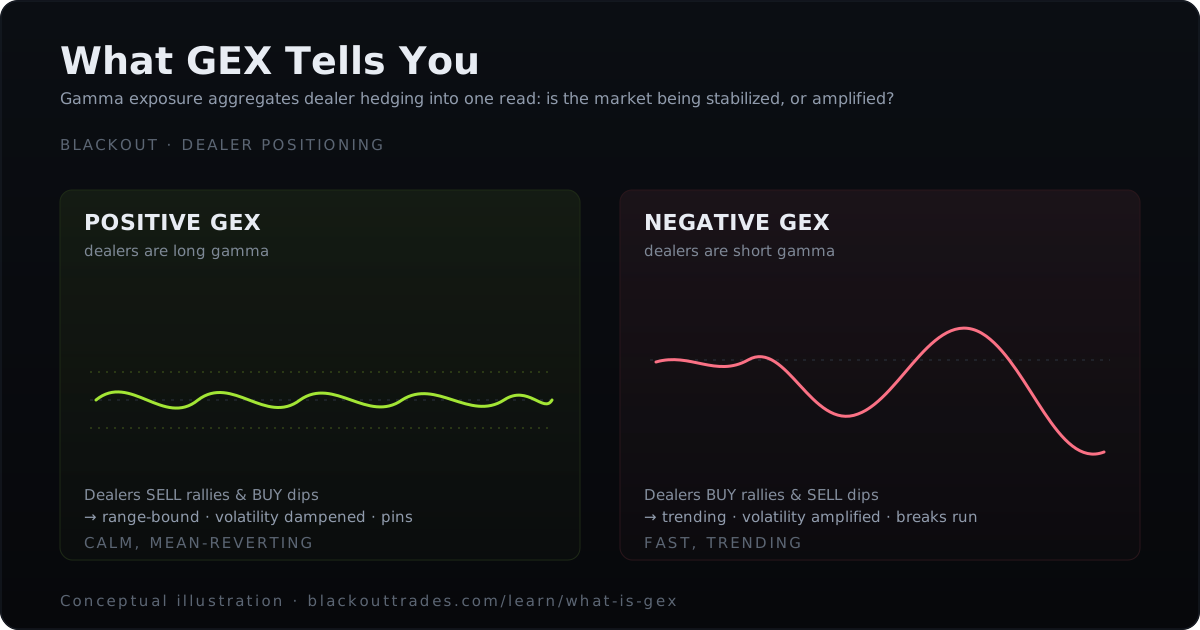
GEX aggregates the gamma of every open option on an underlying (like SPX) into a total measure of dealer positioning. Positive GEX means dealers are net long gamma and tend to stabilize the market; negative GEX means they're net short gamma and tend to amplify moves. (For the mechanics under the hood, start with What Is Dealer Gamma Exposure?. For what gamma itself measures, see Options Greeks Explained.)
Positive GEX: the market self-corrects
In a high positive-GEX environment, dealer hedging leans against price — selling rallies, buying dips. Volatility is suppressed, ranges are tight, and mean-reversion strategies — like fading moves away from VWAP — tend to work. Think slow, grinding days.
Negative GEX: the market self-reinforces
In negative GEX, hedging flows with price. Selloffs feed on themselves, rallies can go parabolic, and realized volatility jumps. This is the regime behind most of the scary red days — and the sharp V-shaped reversals. See how a violent version of this unfolds in Gamma Squeeze Explained.
Reading GEX in practice
Numbers help make this tangible. When aggregate SPX GEX is at +$5 billion, dealers need to sell roughly $5 billion in stock for every 1% up-move and buy the same for every 1% down-move. That's a massive stabilizing force — price has to fight through a wall of mechanical selling to rally, and a wall of mechanical buying to sell off. The result is compression: the session's range tightens, realized vol underperforms implied, and premium-selling structures like the iron condor have a higher probability of staying in the zone.
When GEX flips to -$3 billion, the picture inverts. Now every 1% decline forces dealers to sell roughly $3 billion more, pushing price further down, which triggers more selling. A small gap down at the open becomes a momentum day. Range-bound assumptions get punished; directional conviction (and tight risk management) gets paid.
The exact dollar value matters less than the sign and relative magnitude. A GEX reading in the top quartile of its recent range screams "chop day." A reading in the bottom quartile warns of trend potential. And crossing zero — the gamma flip — is the regime change that rewires the playbook entirely.
GEX and the flip level
The price where total GEX crosses zero is the gamma flip — the boundary between the two regimes. Watching where price sits relative to that line is the fastest read on the day's likely behavior. The delta hedging that actually generates these flows is covered in Delta Hedging Explained.
GEX and implied volatility
GEX and implied volatility are two sides of the same coin. High positive GEX mechanically suppresses realized volatility — dealers are selling rallies and buying dips, compressing the range. When realized vol drops below what IV was pricing in, options are overpriced relative to what's actually happening, and premium sellers benefit from both theta decay and the IV contraction that follows. Conversely, negative GEX amplifies realized vol: moves overshoot, the session's range blows past what IV implied, and option buyers get paid. Checking GEX alongside the VIX (the market's 30-day implied vol for SPX) tells you whether the volatility the market is pricing is likely to understate or overstate what actually plays out — a direct input into whether you want to be a net buyer or seller of premium on any given session.
How to actually use it
GEX is a context tool, not a signal by itself. Use it to decide how to trade — fade extremes in positive GEX, respect momentum in negative GEX — and combine it with the call wall and put wall for specific levels. On a practical level:
- High positive GEX: Sell premium, fade range extremes, expect tight ranges. Good days for iron condors and mean-reversion entries. - Low or negative GEX: Respect momentum, widen stops, consider directional entries. Poor days for premium selling; strong days for trend-following. - Near-zero GEX: The messiest regime. Price oscillates across the flip. Reduce size or wait for a commitment.
See it live
Ready to apply this on SPX? Start with How to Trade SPX Options — regime, walls, and structure before direction.
BlackOut Thermal computes and visualizes GEX across strikes and expirations in real time — the gamma profile, the flip, and the walls on one screen. See it in action →
BlackOut provides educational tools and market analysis only and does not provide investment advice. Options trading involves substantial risk and is not suitable for every investor.
Related guides
Gamma Flip Explained: The Single Most Important Level on the Board
The gamma flip is the price where dealers switch from stabilizing the market to amplifying it. Learn to find it and why it defines the character of the day.
What Is Dealer Gamma Exposure? A Trader's Guide to Reading the Market Like the Desks Do
Dealer gamma exposure explains why the market pins, accelerates, or reverses at key levels. Learn how to read it — and trade before the crowd moves.
Options Greeks Explained: Delta, Gamma, Theta, Vega
Delta, gamma, theta, and vega explained in plain English — what each Greek measures, how they interact, and why gamma dominates 0DTE trading.
VWAP Trading Explained: The Institutional Anchor
Learn what VWAP is, how it's calculated, why institutions use it as a benchmark, and how to trade around it for mean-reversion and trend confirmation.
Ready to trade with live dealer gamma?
See plans and open the desk — SPX Slayer from $49/mo.
View pricing →