Guide
Night Hawk Evening Edition: Prep for the Next Session
How to read the Night Hawk Evening Edition: ranked session prep, conviction tiers, track record, market context, and morning confirmation workflow.
Every trading session starts the night before. While most retail traders wait for the opening bell, the BlackOut Night Hawk Evening Edition publishes a ranked playbook after the close — five ideas for the next session, each scored, tiered, and managed to hard invalidation levels before you even sit down at the desk.
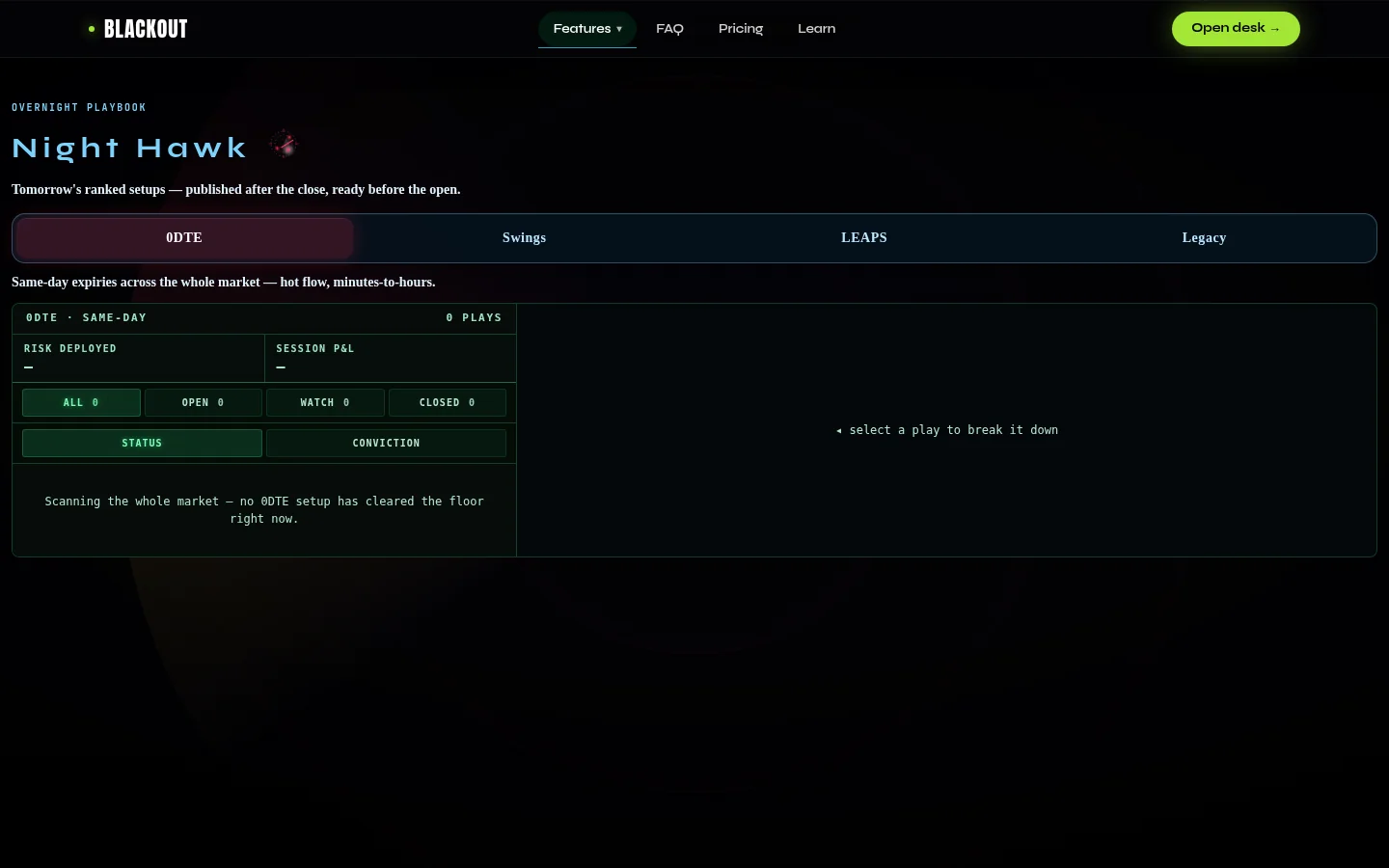
What the Evening Edition delivers
The playbook layout presents five play slots ranked #1 through #5. Each slot carries a complete thesis — not a vague directional lean but a fully specified setup with the data behind it. For every play you see:
- Ticker and direction (long or short) - Conviction tier (A+, A, B, or C — more on these below) - Composite score from the multi-factor scoring engine - Flow streak — how many consecutive days institutional flow has stacked in this direction - IV rank and a premium cap flag indicating whether entry cost is reasonable - Thesis — the one-paragraph argument for the trade - Entry range, target, and stop — concrete levels, not guesses - Options contract — the specific strike and expiry the edition suggests
All of this is derived from the same dealer gamma exposure framework, options flow analysis, and catalyst scanning that powers the rest of BlackOut's desk tools.
The tier system: A+ is earned, never assigned
Night Hawk tiers plays A, B, or C at build time based on three independent factors the raw composite score does not already capture:
- Score band placement — where the play sits in the measured overnight track record. The prime band (40-55) is the sweet spot, averaging +2.99% return historically. The mid band (55-69) produces modest returns. The top band (70+) showed a measured inversion in early data — high raw scores did not mean high returns — so the engine discounts that band (weighted lower, not hard-capped) rather than rewarding it blindly. - Signal breadth — how many of the nine scoring dimensions agree. A play needs at least three confirming dimensions to reach A-tier; fewer than two caps it at B. - Earnings risk — a binary event tomorrow into an overnight hold automatically caps the play at B and adds a penalty.
The critical design choice: A+ is never assignable at build time. It is only earned once a play has at least 10 graded outcomes with an 80%+ win rate. This prevents the system from ever labeling a play "highest conviction" before the evidence supports it — the same honesty spine the 0DTE Command engine uses.
The track record strip: calibration, not prediction
Below the playbook header sits the track record strip — a rolling window (default 30 days) of resolved Night Hawk plays. It shows:
- Total resolved count - Target hit percentage - Profitable percentage (closed above entry, even if target was not reached) - Average return across all resolved plays
When the sample size is small, the strip shows a "building track record" notice rather than percentages that could mislead. Use these numbers for calibration — how the system has performed recently in the current regime — not as a prediction of the next play.
Market context: the macro snapshot
The market context bar captures the end-of-day snapshot carried into the edition: the tide bias (the desk's read on the tape's directional character), SPX and VIX levels (e.g., SPX 5,500, VIX 18), and the session's sector leaders and laggards. This context frames the plays — a bullish semiconductor setup is stronger when the sector led that session, weaker when it lagged.
Morning confirmation: the 9:15 AM ET cron
Overnight, the market does not stand still. Futures move, news breaks, Asia and Europe trade. At 9:15 AM ET, a cron job re-evaluates every play against current conditions and stamps each with a confirmation status:
- CONFIRMED — the thesis holds; levels are intact; the setup is live. - DEGRADED — some supporting conditions have weakened, but the core thesis survives. Proceed with caution or reduce size. - INVALIDATED — the setup is dead. A gap through the stop, a material catalyst reversal, or a regime flip killed it overnight. - UNVERIFIED — the cron could not evaluate conditions (data feed issue, pre-market illiquidity). Treat as unconfirmed until you verify manually.
Read the confirmation badges before the open. A play that was conviction A last night is meaningless if it stamped INVALIDATED at 9:15.
Edition status badges
The edition itself carries a freshness state that tells you what you are looking at:
- Live — tonight's edition is published and current. - Syncing — the edition pipeline is actively building; plays may still be ranking. - Prior — tonight's edition is not published yet; you are seeing yesterday's board. Validate every level before acting. - Legacy — the board is serving from a fallback source, not the first-class pipeline. Data may be incomplete. - Building — the scoring and ranking funnel is running. - Recap only — a market recap published, but no play survived the funnel (all candidates were below the viability threshold).
Data cadences
The Evening Edition refreshes on slower cadences than the intraday desks: 120 seconds for the edition payload, 60 seconds for play status updates (confirmation badges, mark-to-market), and 300 seconds for the track record strip. These are appropriate — overnight plays do not need tick-level updates.
How it fits the desk
Night Hawk is asynchronous preparation, not live execution. It tells you what to watch and where the levels are before the open. Once the bell rings, SPX Slayer and the 0DTE Command scanner take over for intraday execution. The Cortex evidence system provides the deeper analysis layer behind both the evening edition and the intraday scanner. If you want to interrogate the edition conversationally — "Why is NVDA ranked #1?" or "How does the flow streak compare to last week?" — Largo AI can pull the full edition and walk you through it — see tips for getting structured answers.
For a high-level overview of the Night Hawk surface, see the Night Hawk guide. For the broader gamma and flow framework, start with Dealer Gamma & Options Flow: The Complete Guide. New to BlackOut? The Getting Started guide maps every tool. Get access →
BlackOut provides educational tools and market analysis only and does not provide investment advice. Options and equities trading involve substantial risk and are not suitable for every investor.
Related guides
0DTE Command: The Always-On Intraday Scanner
How the 0DTE Command scanner works: session heat states, hard entry gates, confluence system, thesis health, and the always-on multi-ticker intraday engine.
Night Hawk Cortex: The Evidence Brain Behind Every Commit
How the Cortex evidence system works: 8 independent sources, evidence decay, veto asymmetry, conviction bands, and the precision-first commit model.
Largo AI Terminal: Your AI Desk Analyst
How to use Largo AI as your desk analyst: chat interface, tool traces, live data queries, and the questions that get the best structured answers.
What Is Dealer Gamma Exposure? A Trader's Guide to Reading the Market Like the Desks Do
Dealer gamma exposure explains why the market pins, accelerates, or reverses at key levels. Learn how to read it — and trade before the crowd moves.
Ready to trade with live dealer gamma?
See plans and open the desk — SPX Slayer from $49/mo.
View pricing →